
Automation has reshaped plastic injection molding, delivering faster production, less waste, and highly consistent results. At the heart of this transformation are injection molding robots—smart, programmable systems that keep high-volume production running with exceptional precision.
In this guide, we’ll explain what injection molding robots are, how they work, and why facilities like IVIROBOT rely on them to support demanding, large-scale projects.
What Are Injection Molding Robots?
Injection molding robots are programmable robotic systems designed to automate key steps in the plastic injection molding process that would otherwise require manual labor. These robots are typically integrated directly with injection molding machines and can perform tasks such as:
- Loading and unloading molds
- Removing finished parts from the mold
- Placing inserts, labels, or components into the mold
- Handling secondary operations like trimming, inspection, and sorting
By minimizing manual touchpoints, injection molding robots increase accuracy, reduce human error, and create a safer, more controlled production environment—especially in repeatable, high-volume applications.
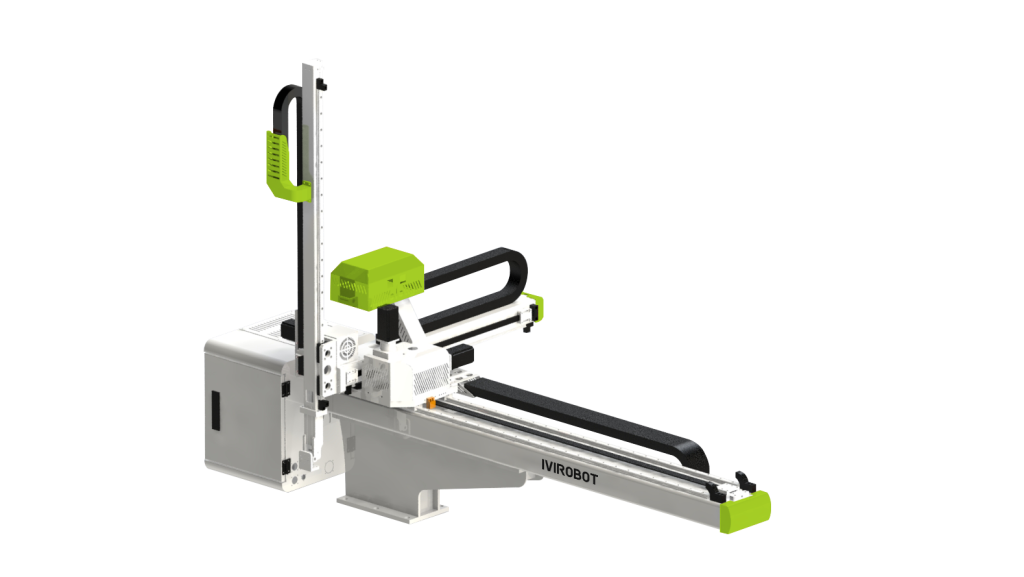
Why Use Injection Molding Robots?
In today’s competitive manufacturing landscape, robotics and automation are no longer optional—they’re essential. Injection molding robots deliver several critical advantages:
1. Speed and Efficiency
Robots can operate continuously, without breaks, fatigue, or shift changes. They:
- Perform repetitive tasks faster than manual operators
- Synchronize perfectly with injection molding cycle times
- Support true 24/7, lights-out production
This makes injection molding robots ideal for manufacturers who need to maximize throughput and meet tight deadlines.
2. Consistency and Precision
Every cycle matters in injection molding. Robots ensure that:
- Each part is handled the same way, every time
- Part removal, insert placement, and labeling are highly repeatable
- Variation is minimized, improving dimensional accuracy and overall quality
By standardizing critical tasks, injection molding robots help reduce scrap rates, limit defects, and support tight tolerance requirements.
3. Reduced Labor Costs
While the initial investment in injection molding robots can be significant, the long-term savings are substantial:
- Lower reliance on manual labor for repetitive tasks
- Reduced training and turnover costs
- Higher productivity with the same or smaller team
For large production runs, these savings can quickly offset the upfront cost of automation.
4. Improved Human Safety
Injection molding involves hot materials, moving machinery, and repetitive motions. By automating high-risk and repetitive tasks, injection molding robots:
- Reduce the risk of workplace injuries
- Minimize operator exposure to hazardous conditions
- Free up skilled employees to focus on higher-value, strategic work
The result is a safer, more efficient production environment.
Injection Molding Robots and High-Volume Production
Automation delivers the greatest value in high-volume injection molding. When you’re producing thousands—or even millions—of identical parts:
- Even minor process variation can create costly defects
- Small handling inconsistencies can lead to cosmetic flaws or dimensional drift
- Manual operations can become bottlenecks
Injection molding robots help maintain:
- Tight tolerances across long production runs
- Uniform handling and cooling conditions
- Consistent quality from the first part to the last
For manufacturers focused on large-scale production, automation is not just a competitive advantage—it’s a requirement.
The Future of Robotics in Injection Molding
The role of injection molding robots will continue to expand as new technologies emerge. Advancements in:
- AI and machine learning
- Real-time data analytics and monitoring
- Predictive and preventive maintenance
will make robotic systems even smarter and more connected. These innovations will:
- Further reduce defects and downtime
- Optimize cycle times and energy use
- Improve traceability and quality documentation
Manufacturers that invest in robotics and automation today will be better prepared to handle future challenges—from labor shortages to stricter quality and regulatory demands.
IVIROBOT: Your Partner for Injection Molding Robots and Automated Production
At IVIROBOT, we believe that embracing automation is essential for delivering consistent, high-quality plastic parts at scale. Our expertise with injection molding robots allows us to:
- Support high-volume, repeatable production with exceptional precision
- Integrate advanced robotic systems with modern injection molding equipment
- Maintain continuous uptime for demanding, large-scale projects
Whether you’re launching a new plastic part or scaling an existing product line, IVIROBOT provides:
- Automated robotic handling tailored to your application
- An experienced engineering and operations team
- Reliable, efficient production built around modern injection molding robots
If you’re ready to improve consistency, reduce costs, and future-proof your plastic molding operations, partnering with IVIROBOT is a powerful next step.