
In Mold Labeling Introduction
In mold labeling (IML) is an advanced labeling technology that integrates the label and the plastic container into one single molding process. Instead of applying a self‑adhesive label after production, in mold labeling uses a printed OPP label that is placed inside the mold cavity and fused with the plastic during injection molding, blow molding, or thermoforming.
This process has gradually replaced traditional self‑adhesive labels in many applications and is now widely used across food packaging, industrial containers, and consumer products.
What Is In Mold Labeling?
In mold labeling is a process where a printed label is inserted into the mold and becomes part of the finished plastic product during molding.
In a typical in mold labeling injection molding process:
- Printed and die‑cut IML labels are stacked in a magazine.
- An automatic robot picks up each label and positions it precisely in the open mold cavity.
- Using vacuum suction and electrostatic adsorption, the label is fixed against the inner surface of the mold.
- When molten plastic is injected into the cavity, it bonds with the back of the label.
- After cooling, the plastic container and the label are fully integrated, resulting in durable and high‑quality decoration.
This technology ensures excellent label adhesion and a premium print appearance throughout the life of the product.
What Is IML Packaging?
IML packaging (in mold labeling packaging) refers to packaging containers that are produced and decorated in a single step using the in mold labeling process. The container and the printed label are formed together, which means:
- No label foaming
- No wrinkles or misalignment
- No peeling or flaking during use
In addition, in mold labeling printing supports high‑resolution graphics and special visual effects, such as metallic finishes, holographic effects, and laser or aluminum coating. This significantly upgrades the look and feel of the packaging and enhances brand value on the shelf.
Examples and Applications of In Mold Labeling
In mold labeling is widely adopted as a high‑efficiency plastic container production process. A robot places the printed label into the mold, and the container is formed and decorated in one injection cycle.
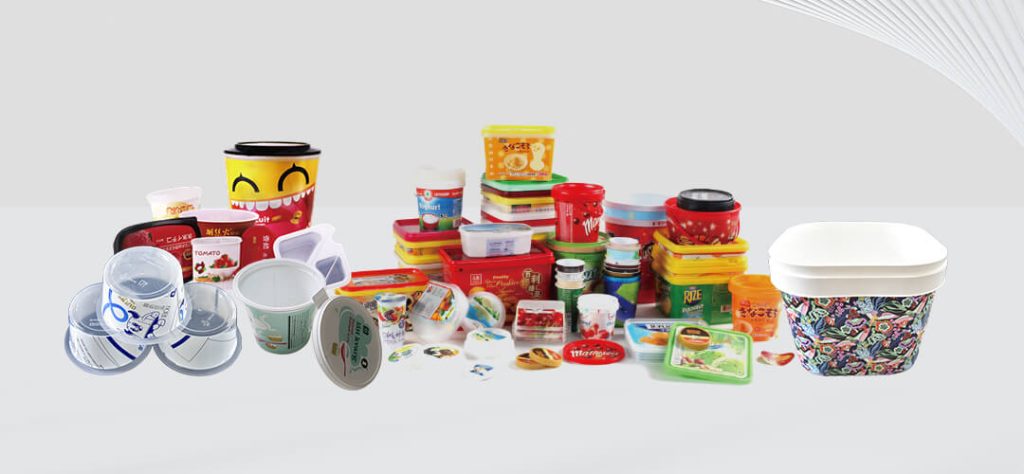
Thanks to its attractive appearance, lower overall decoration cost, and high production efficiency, in mold labeling is now commonly used in:
- Ice cream containers
- Yogurt cups
- Butter containers
- Milk tea and beverage cups
- Sauce and dip cups
- Various disposable food packaging containers
- Paint buckets and pails
- Sports equipment exterior parts
- Automotive interior components
For manufacturers looking to improve branding and streamline production, in mold labeling provides a robust, scalable solution.
In Mold Labeling Process: Step‑by‑Step
The in mold labeling process combines container molding and labeling into a single operation. A general workflow includes:
- Label Design and Size Definition
Design the label dimensions and artwork according to the shape and labeling area of the container. Produce the IML labels accordingly. - Labeling Fixture and Robot Integration
Develop suitable labeling fixtures and use a robot to place the labels into the mold. This ensures that the labels fully match and cover the container’s target surface. - Plastic Injection and Label Fusion
Inject molten plastic into the mold. Under high temperature, high speed, and high pressure from the injection molding machine, the plastic and the in mold labeling material become fully integrated. - Cooling and Solidification
Allow the plastic to cool and harden inside the mold so that the label bonds firmly to the container wall. - Part Ejection and Next Cycle
When the part is ejected, the mold cavity is already prepared for the next in mold labeling cycle with a new label. This maintains the integrity, accuracy, and consistency of every label.
Types of In Mold Labeling Process
1. In Mold Labeling Injection Molding
In mold labeling injection molding uses advanced injection technology with customized IML equipment:
- The robot picks labels from a magazine
- Labels are positioned on the inner wall of the injection mold cavity
- The mold closes and plastic is injected
- After cooling, the mold opens and the labeled product is removed
The heat of the molten plastic permanently bonds the label to the container, creating a high‑quality decorative surface in a single step.
2. In Mold Labeling Blow Molding
In in mold labeling blow molding:
- The printed IML label is placed into the blow mold cavity before blowing
- During blowing, under high temperature and high pressure, the surface of the IML label melts and fuses with the surface of the bottle or hollow part
- When the mold opens, a fully decorated bottle or blown part is produced in one cycle
This method is widely used in bottles and hollow containers that require 360‑degree decoration.
3. Thermoforming (Blister) In Mold Labeling
In thermoforming in mold labeling:
- Printed labels are placed into the thermoforming or blister mold before forming
- Under high temperature and pressure during thermoforming, the label material bonds closely to the sheet surface
- The result is a seamless connection between the label and the finished product
This approach is ideal for trays, lids, and other formed packaging parts.
In Mold Labeling Technology
In Mold Labeling Printing Technologies
Common in mold labeling printing processes include:
- Gravure Printing (Intaglio)
Ideal for bright colors, high saturation, and strong visual impact. Recommended for large‑volume IML orders. - Offset Printing
Suitable for simpler designs and high‑efficiency printing. Often used for small and medium production runs. - Flexographic Printing
Delivers rich color layers and fine tactile effects with raised or textured finishes, well suited for premium packaging.
In Mold Labeling Equipment
In mold labeling equipment is a high‑efficiency, high‑precision automation system widely used in food container production. A typical IML system includes:
- Label magazines and pick‑and‑place robots
- Custom IML tooling and labeling fixtures
- Electrostatic systems to fix labels inside the mold cavity
- Integrated in mold labeling control with the injection or blow molding machine
- Vision inspection systems for label position and quality
- Automatic stacking and packaging systems
This high level of automation ensures consistent in mold labeling quality and stable, repeatable production.
How Does In Mold Labeling Work?
To understand how in mold labeling works, it helps to see how it replaces traditional post‑labeling:
- Pre‑printed and die‑cut labels are stacked as single sheets in the label magazine.
- A robot picks up each label and moves it into the open mold cavity.
- The label’s printed side faces inward, while the adhesive or heat‑activated side faces the plastic.
- Using vacuum negative pressure or electrostatic charge, the label is firmly attached to the mold wall.
- The mold closes, molten plastic is injected or blown in, and the label and plastic fuse together.
- After cooling, the part is demolded as a fully decorated product with an in mold label that will not peel or wrinkle.
By integrating labeling directly into the molding process, in mold labeling eliminates a complete downstream labeling step.
In Mold Labeling Materials
In mold labeling materials are typically OPP‑based films engineered for high temperature and pressure conditions. IML films often have a three‑layer structure:
- Printable Layer – Optimized for high‑quality printing and color reproduction.
- Core Layer (Main Body Layer) – Provides mechanical strength and stability to the label.
- Thermal Melt Layer – Ensures strong adhesion between the label and the molten plastic during the in mold labeling process.
This multilayer design allows the label to maintain excellent stability, adhesion, and appearance even in demanding molding conditions.
In Mold Labeling vs. In Mold Decorating
Although related, in mold labeling (IML) and in mold decorating (IMD) serve different purposes and products:
- In Mold Labeling (IML)
A type of in‑mold decoration focused on integrating printed product labels with plastic parts during injection molding.- Provides high‑clarity, wear‑resistant surface graphics
- Highly efficient and cost‑effective
- Ideal for products that require detailed patterns, branding, and durability (e.g., food containers)
- In Mold Decorating (IMD)
Uses printed films or decorative sheets formed in the mold to create textured or patterned surfaces.- Typically involves sheet, resin, and ink systems
- Offers fast production speed, stable yield, and low cost
- Widely used in 3C electronics and products with rapid design changes and short life cycles
Understanding the difference helps brands choose the right in mold labeling or in‑mold decorating solution for their application.
In Mold Labeling Applications
As an innovative packaging solution, in mold labeling has been popular in developed markets for many years and is now rapidly growing in regions like China.
Today, in mold labels are widely used on the surface of food packaging containers and play an important role in:
- Product identification and branding
- Logistics and supply chain traceability
- Anti‑counterfeiting and security
- Consumer information and regulatory compliance
By replacing traditional labeling equipment, in mold labeling:
- Reduces overall production costs
- Improves container recyclability
- Minimizes secondary packaging
- Shortens production cycles
- Increases line efficiency
This makes in mold labeling especially attractive to the food and packaging industries.
Advantages and Benefits of In Mold Labeling
In mold labeling offers several key advantages compared to traditional labeling technologies:
- Superior Appearance
The label and product are fully integrated, giving a uniform, high‑end look. Labels do not peel, fade, or crack, keeping products attractive throughout their lifecycle. - Lower Overall Cost
By removing downstream labeling steps, in mold labeling can significantly reduce labor, labeling time, and related environmental costs. - Environmentally Friendly
Labeling is completed during molding, reducing secondary processes and waste. No extra label carriers or adhesives are required, making in mold labeling more sustainable than many conventional methods. - High Efficiency and Accuracy
Automated IML systems provide precise label placement and high‑speed operation, allowing manufacturers to maintain high productivity and consistent quality.
Real Costs of In Mold Labels
The total cost of in mold labels is typically composed of:
- Raw material cost
- Label production cost
- Machine processing and molding cost
- Packaging and transportation cost
By carefully selecting the right material and optimizing label design according to the real use case and appearance requirements, manufacturers can reduce in mold labeling costs significantly—often saving 50–70% on materials and labels compared to less optimized setups.
In Mold Labeling Services
A professional IML partner can provide end‑to‑end in mold labeling services, including:
- Product and container design
- IML label design and artwork optimization
- Prototyping and sample manuals
- Mold design and manufacturing
- Product performance testing
- Mass production with integrated in mold labeling
With over ten years of experience in injection molding IML products, many suppliers serve major food brands such as Nestlé, Mondelez, and others, proving the maturity and reliability of in mold labeling technology in demanding applications.
How to Choose an In Mold Labeling Supplier
When selecting an in mold labeling supplier, consider the following criteria:
- Professional Expertise and Experience
Proven track record in IML product design, mold development, and process optimization. - Customization Capability
Ability to customize containers, labels, and molds according to your specific requirements. In‑house design and engineering teams are a strong advantage. - Quality and Precision
High‑precision mold manufacturing and process control to ensure correct dimensions, excellent surface finish, and consistent IML performance. - Stable Production Capacity
Robust production management systems and process control to support stable, long‑term supply. - Product Performance
Verified performance in real application environments, with the ability to meet all required testing and certification standards.
Future Trends and Innovations in In Mold Labeling
Compared with traditional labeling methods, in mold labeling offers superior appearance, durability, and economic benefits. As consumers increasingly focus on product aesthetics and brand experience, in mold labeling will continue to expand across multiple industries.
In high‑volume consumer markets:
- Brands prioritize strong shelf impact and digital/online presentation
- Products must stand out visually and maintain consistent brand identity
In mold labeling helps brands achieve these goals and becomes a key factor in market competition.
Looking ahead, with ongoing technological advancements and cost reductions, in mold labeling will be adopted in even more sectors. Breakthroughs in high‑barrier materials and biodegradable or sustainable IML films will further enhance its potential, making the market outlook for in mold labeling extremely promising.