
In-mold labeling (IML) is an advanced packaging decoration technique in which a pre-printed polypropylene (PP) label is placed inside a mold that forms the final plastic product, such as a butter tub or food container. During molding, molten PP is injected or blown into the mold. As it cures, the plastic fuses with the label, and both take the exact shape of the mold.
The result: the label and the container become a single, integrated product—no need for separate labeling after production.
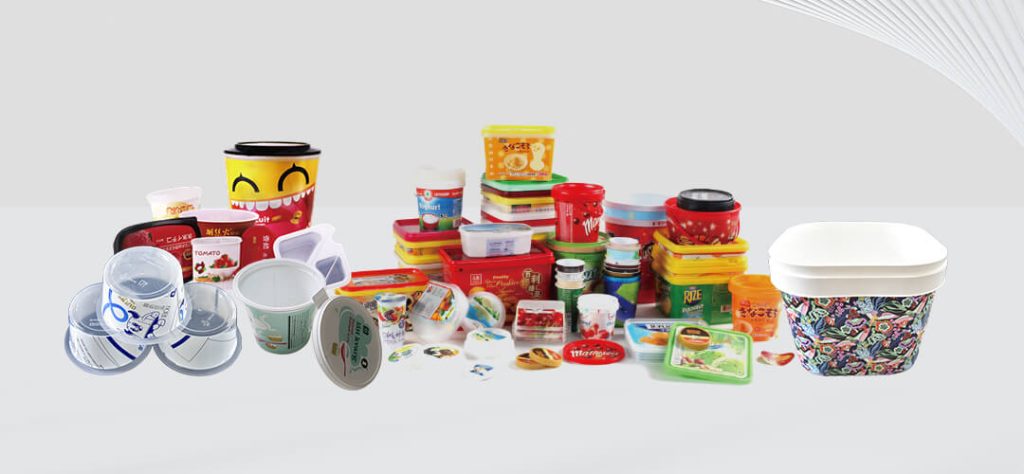
In-Mold Labeling Processes
In-mold labeling can be used in several plastic packaging production processes:
- Injection Molding IML
Ideal for rigid containers such as tubs, lids, cups, and pails. The label is placed in the injection mold, and molten PP is injected, bonding the label to the container wall. - Blow Molding IML
Commonly used for bottles and hollow containers. The label is positioned in the blow mold, and the expanding molten plastic adheres to the label surface. - Thermoforming IML
Suitable for lightweight and thin-walled packaging. A pre-printed label is placed into the thermoforming mold before a heated plastic sheet is formed over it.
These three techniques give brand owners and packaging manufacturers great flexibility to choose the most suitable IML solution for their product range.
Key Advantages of In-Mold Labeling
1. Maximum Print Quality and 360° Decoration
Using high-quality offset printing, IML labels deliver:
- High-resolution images and fine details
- Vivid colors and consistent print quality
- Full-surface decoration, allowing all sides of the container to be covered with one single label
This creates strong shelf impact and supports premium brand positioning.
2. Strong, Hygienic, and Durable Labels
In-mold labels are directly fused with the container, making them:
- Resistant to humidity and condensation – ideal for refrigerated and frozen products
- Stable under large temperature changes – suitable for cold chain and some heat-fill applications
- Scratch- and crack-resistant – graphics remain intact throughout transport and handling
- Free from wrinkles and label lift – no peeling corners or label misalignment
Because the label is part of the packaging wall, IML offers a hygienic, closed surface that is easy to clean and suitable for many food applications.
3. Shorter Production Time and Lower Costs
IML combines packaging production and decoration in a single step:
- Containers are produced and labeled in one integrated process
- No separate labeling line or post-molding decoration is required
- Blank container storage becomes unnecessary, reducing warehouse space
- Lower transportation and handling costs for undecorated components
Overall, this can significantly reduce total cost of ownership and simplify logistics.
4. Sustainable, Mono-Material IML Packaging
In-mold labeling supports circular packaging strategies:
- Both the container and the label are made from polypropylene (PP)
- The result is mono-material packaging that is easier to recycle
- No need to remove labels before recycling, simplifying the process
By choosing recyclable PP and suitable inks, brands can improve the sustainability profile of their packaging and align with increasingly strict recycling regulations.
5. Wide Range of Looks, Textures, and Functional Options
With IML, it is possible to decorate the same basic plastic container with many different label types, finishes, and functionalities, for example:
- Visual & tactile effects:
- Matte or glossy finishes
- Metallic, transparent, or “no-label look”
- Soft-touch or textured surfaces
- Functional enhancements:
- Barrier labels for extended shelf life (depending on construction)
- Light-blocking labels for sensitive products
- Special inks and lacquers for added performance
This flexibility allows brands to easily differentiate products on the shelf and tailor the packaging to different market segments.
6. Compatibility With Many Container Shapes
In-mold labeling can be applied to a broad variety of shapes, including:
- Round and oval tubs
- Square and rectangular containers
- “Sqround” (square-round hybrid) designs
- Custom or special shapes
This versatility makes IML a strong option across many food and non-food applications.
7. Fast and Efficient Design Changeovers
Switching from one design to another is simple:
- Only the label artwork and reel or stack need to be changed on the IML automation system
- No new molds or large-scale machine modifications are required
- Startup waste for new designs is very low
This is particularly valuable for:
- Seasonal promotions
- Limited editions
- Multi-language or multi-brand packaging
Key Partners in a Successful IML Project
To achieve the best results with in-mold labeling, it is important to involve all relevant partners from the beginning:
- Label supplier – for label substrate, print, inks, lacquers, and functionality
- Injection, blow, or thermoforming machine supplier – for process parameters and integration
- Mold maker – for mold design optimized for IML compatibility
- Automation/robotics partner – for precise label placement and handling
Sharing technical and production parameters between all partners early in the project helps to:
- Optimize cycle times and efficiency
- Ensure strong label adhesion and visual quality
- Minimize waste and reduce trial time
- Guarantee consistent, reliable IML performance
We at IVIROBOT are also a one-stop solution provider for injection molding IML. You are welcome to get in touch with our experts.