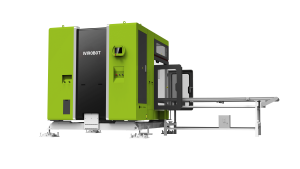
Few fields have evolved as rapidly as the packaging and labeling industry, and at the center of that evolution is in mold labeling (IML). As supply chains become more complex and logistics more demanding, industrial and reusable packaging must deliver long‑lasting performance while maintaining clear, attractive identification.
Today’s reusable totes, containers, and bins need labels that are:
- Visually appealing and easy to read
- Resistant to continuous handling and impact
- Able to endure harsh industrial washing and logistics conditions
In mold labeling meets all these requirements by integrating the label into the container wall during production, rather than applying it afterward.
What Is In Mold Labeling and Why It Matters
In mold labeling is a process where a printed label is placed inside the mold before plastic is injected or formed. When the plastic cools, the label and container become a single, unified part.
For reusable and industrial packaging, this means:
- No peeling, bubbling, or label loss
- A smooth surface with a “no‑label look”
- Stable branding and identification for the entire life of the container
The growth of in mold labeling is driven by:
- Its cost‑effectiveness for medium and large volumes
- The mechanical strength and consistency of molded‑in labels
- Customer demand for convenient, premium, and sustainable packaging
Core Performance Benefits of In Mold Labeling
By fusing the label directly to the container, in mold labeling transforms packaging into a reinforced plastic component with superior performance:
- Scratch resistance – labels remain readable under rough handling
- Waterproof and moisture resistant – ideal for washing, wet environments, and outdoor use
- Chemical resistance – able to withstand cleaning agents and industrial fluids
- UV resistance – graphics stay legible and attractive despite sun or UV exposure
- Repeat‑use durability – labels stay intact through repeated cycles of use and cleaning
For industrial totes and returnable transport packaging, these advantages turn in mold labeling into a long‑term, low‑maintenance solution.
In Mold Labeling and Sustainability
Sustainability is another key reason why in mold labeling is gaining traction among manufacturers.
Many IML containers are designed as fully monomaterial:
- The container and the in mold label are produced from the same base resin (often PP or HDPE)
- No separate paper labels or extra adhesive layers are required
- Sorting and recycling become simpler and more efficient
Compared with traditional pressure‑sensitive labels, in mold labeling enables:
- Easier mechanical recycling
- Reduced contamination of recycling streams
- Lower packaging waste over the product’s lifetime
This combination of durability and recyclability aligns IML with tightening regulations and brands’ sustainability goals.
In Mold Labeling and the Logistics Revolution
In today’s logistics environment, efficient, returnable, and trackable packaging is essential. In mold labeling is redefining asset control for:
- Reusable totes
- Storage bins
- Distribution crates
- Industrial trays
By using in mold labeling, companies can permanently integrate key data directly onto the container:
- Barcodes and QR codes
- Handling and safety instructions
- Warning symbols and compliance markings
- Ownership or asset IDs
Because the information is molded into the structure, the label:
- Survives aggressive washing and sanitization
- Stays readable after many handling cycles
- Does not peel off, tear, or need replacement
This permanent identification reduces:
- Misidentification and picking errors
- Asset loss and misplacement
- Manual relabeling and maintenance work
Improving traceability and durability with in mold labeling is a practical way to address everyday warehousing and distribution challenges.
How Technology Is Advancing In Mold Labeling
Ongoing technological progress is expanding what in mold labeling can do and how efficiently it can be deployed.
1. Robotics and Automation in IML
Modern robotic handling systems for in mold labeling can:
- Precisely recognize label position and orientation
- Use sensors and 3D profiling to adjust for movement and coordinate shifts on conveyors
- Place labels accurately into the mold at high speed
This level of automation:
- Reduces downtime and human error
- Improves yield and label positioning quality
- Supports cost‑effective scaling for large production runs
Research in visual object recognition and convolutional neural networks (CNNs) further strengthens robot capabilities, helping them develop effective “hand‑eye coordination” for label handling and part manipulation in IML processes.
2. Digital Printing for In Mold Labeling
Advances in digital printing have made in mold labeling more flexible and responsive:
- Short runs and frequent design changes become more economical
- Prototyping and sampling can be done quickly
- Variable data and custom graphics can be integrated for specific customers or regions
However, for in mold labeling to perform reliably, two factors remain critical:
- Ink quality – must withstand molding temperatures, chemicals, UV exposure, and washing
- Precision die cutting – labels must be perfectly sized and shaped to fit the mold cavity and maintain clean edges
When these parameters are optimized, digital printing turns in mold labeling into a powerful tool for both branding and functional identification.
3. Smart In Mold Labeling: RFID, NFC, and Barcodes
One of the most exciting developments is the integration of smart labeling technologies into in mold labeling systems, including:
- RFID (Radio Frequency Identification)
- Barcodes and QR codes
- NFC (Near Field Communication)
- Automated applicators and readers
By combining in mold labeling with these technologies, companies can achieve:
- Real‑time product and asset identification
- Visibility into container status, location, and usage history
- Seamless data integration with warehouse management and tracking systems
End‑to‑end traceability via smart in mold labeling supports:
- Better inventory accuracy
- Stronger regulatory compliance
- More effective anti‑counterfeiting measures
This results in smoother operations and more informed decision‑making across the supply chain.
In Mold Labeling and the Future of Resilient Packaging
In mold labeling has rapidly evolved from a niche decoration technique into a strategic enabler of resilient packaging. In an era of:
- Supply chain disruptions
- Increasing sustainability requirements
- Rising expectations for quality and performance
in mold labeling stands out as a way to combine innovation, durability, and circularity in a single solution.
For packaging engineers, logistics managers, and brand owners, investing in in mold labeling means:
- Longer‑lasting and more reliable packaging assets
- Reduced total cost of ownership over the product lifecycle
- Stronger brand image and compliance positioning
By embracing in mold labeling, professionals can build packaging systems that are ready for future challenges—robust, smart, sustainable, and designed to perform from first use to final recycling.